
Why Pool Halls Are Adelaide’s Best Spot for Making New Friends Alone

Going out alone can feel harder than it should. You leave home wanting a good night, then arrive somewhere loud, crowded, and full of groups who already seem settled. Starting a chat out of nowhere can feel awkward. Standing around with a drink can feel worse.
That is where pool changes the whole equation.
A pool hall gives you something to do the second you walk in. You are not just “the person alone at the bar”. You are there to play. That small shift makes it much easier to relax, speak to someone, and let a proper conversation happen without forcing it.
In Adelaide, where nights out often move between pubs, small bars, live music, and late food, pool sits in a sweet spot. It is social without being intense. Casual without being boring. Competitive enough to be fun, but slow enough that people can talk between shots.

Pool gives everyone a reason to talk
The hardest part of meeting people alone is the opening line. Most social spaces do not give you an obvious one.
At a bar, “How’s your night going?” can work, but it can also land flat. On a dance floor, chatting is usually impossible. At a gig, people are focused on the stage. At a restaurant, tables are private territory.
Pool is different because the game creates natural openings:
“Are you playing winner stays on?”
“Mind if I jump in next round?”
“Is this table free after your game?”
“Nice shot. Did you mean that?”
“Do you know the rules they’re playing here?”
None of those lines feel random. They fit the room.
That matters because friendship often starts with small, low-pressure contact, not one big perfect conversation. Pool gives you repeated chances to talk. You chat while racking balls. You laugh after a bad shot. You ask who is next. You compare questionable rules. You congratulate someone after a clean finish.
There is also a useful rhythm to the game. You are not locked into constant eye contact. One person shoots, others watch. Then someone else steps up. Conversation can pause without becoming awkward.
For anyone going out alone, that rhythm is gold. It lets you join the room bit by bit.
It is social, but it does not demand a performance
Some nights out come with pressure. Dress a certain way. Dance well. Be witty. Know the right people. Look like you belong.
Pool is more forgiving.
You can be a beginner and still have a good time. In fact, being average at pool can make you easier to talk to. A missed shot gives people permission to laugh with you. A lucky pot becomes a shared moment. A simple “I’m still learning” is often enough to invite tips, jokes, and a quick lesson.
A pool hall also suits different kinds of people. Quiet people can ease in through the game. Outgoing people can talk to half the room. Competitive people can chase rematches. Newcomers can watch for a while before playing.
That mix helps because no one has to carry the whole social experience. The table does some of the work.
Pool also keeps phones away more naturally than many other settings. You need your hands. You need to watch the table. People still check messages, of course, but the game gently pulls attention back into the room. That makes the place feel more present.
And when people are present, they are easier to meet.

Adelaide makes the solo pool night easier
Adelaide has a social scale that works in favour of a solo night out. It is big enough to have plenty happening, but small enough that places can feel familiar after a couple of visits.
That is a good balance for meeting people.
In a larger city, venues can feel anonymous. In a smaller town, going out alone can feel too visible. Adelaide sits neatly between those extremes. Whether the night starts in the CBD, near a pub strip, or around a suburban venue, it is common to see mixed groups, couples, after-work crowds, students, visitors, and regulars sharing the same room.
Pool suits that mix.
It is also a good bridge activity. A night can start with one game, turn into a doubles match, then continue with food, another drink, or a walk to the next spot. You are not committing to a whole evening with strangers. You are committing to one rack.
That makes it easier to say yes.
The city’s pace helps too. Adelaide nights can be lively without always feeling frantic. Many people are open to a chat when the setting feels casual. Pool creates that casual setting better than almost anything else because the social rules are clear.
You wait your turn. You respect the table. You do not crowd someone’s shot. You offer a rematch if the game was close. You shake off bad luck.
Those simple rules make a room feel easier to read, even if you have never been there before.
A table gives you a place to belong
One underrated benefit of pool is that it gives you a physical anchor.
When you arrive alone at many venues, the first question is silent but stressful: where do I stand?
Near the bar can feel like you are waiting. Against a wall can feel isolated. Sitting at a table alone can feel too fixed. Walking around can feel aimless.
A pool table solves that. Once you are playing, watching, or waiting for a turn, you have a reason to be exactly where you are.
That sense of place changes your body language. You look more comfortable because you are doing something. Other people read that. They are more likely to include you if you seem relaxed and part of the flow.
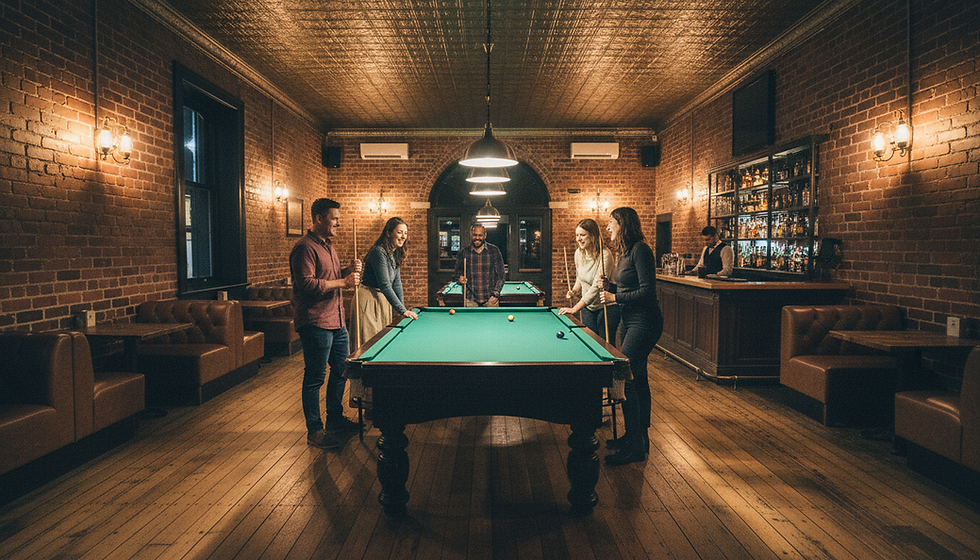
The table also makes groups more open. A group of four at a dining table feels closed. A group of four around a pool table often has gaps. Someone is chalking a cue. Someone is leaning nearby. Someone is checking the next shot. Someone is waiting for the game to end.
Those little gaps are where a solo person can join.
If the venue runs casual games, winner-stays-on rules, or a chalkboard for turns, even better. The system itself invites new players. You do not need to break into a private group. You just add your name, ask who is up, and follow the room’s pattern.
A good pool hall feels less like a crowd of separate groups and more like a loose social loop.
How to make friends without making it weird
The best solo nights usually start small. The goal is not to walk in and become everyone’s favourite person in ten minutes. The goal is to create enough small moments that one of them turns into a real connection.
Here are a few ways to make that happen naturally.
Arrive before the room is packed
If you feel nervous, avoid walking in at peak chaos. Early evening is easier. People are still settling in. Tables are turning over. Staff are less rushed. It is simpler to ask how games work or whether there is a queue.
An earlier start also gives the night room to build. By the time groups arrive, you may already know the table, the rules, or a couple of names.
Ask to join, not to interrupt
Pool has its own etiquette. A simple ask goes a long way.
Try:
“Are you playing singles, or can I jump in after?”
“Do you mind if I put my name down for the next game?”
“Are you waiting on someone, or is that table opening up?”
Keep it friendly and accept the answer. If people are having a private game, no problem. There will be another table, another round, another opening.
Be honest about your skill level
You do not need to pretend you are better than you are. Most casual players respect honesty.
Say something like:
“I’m decent, but inconsistent.”
Or:
“I’m here for a hit, not a championship.”
That sets the tone. It tells people you are up for fun, not there to dominate the table or argue over every rule.
If you are genuinely good, keep it light. No one enjoys being trapped in a casual game with someone treating every shot like a final.
Use doubles to your advantage
Doubles is one of the easiest formats for meeting people. It gives you a teammate, shared jokes, and someone to talk to between turns.
If three people are waiting, offer to make it doubles. If two groups are hovering around one table, suggest pairing up. It is a simple way to turn strangers into temporary allies.
Temporary allies often become real acquaintances.
Learn names early
Names make a casual game feel warmer. You do not need a grand introduction. Just ask after the first few shots.
“I’m Sam, by the way.”
That tiny line changes the energy. It becomes easier to cheer someone on, tease a lucky shot, or suggest another game later.
Keep the mood generous
Pool can bring out strange levels of competitiveness. That can be fun, but only if the mood stays relaxed.
A few habits help:
Compliment good shots.
Laugh at your own misses.
Avoid giving advice unless someone asks.
Do not blame the table every time.
Offer a rematch if the game was close.
Step back when someone is lining up.
People remember how you make the game feel. If you are easy to play with, people are more likely to invite you into the next round.
What to look for in a good solo-friendly venue
Not every venue has the same social feel. Some tables sit in a corner as background entertainment. Others form the heart of the room.
For meeting people, look for places where pool is visible, shared, and casual.
A solo-friendly spot usually has:
Open table areas with space to stand and watch
Clear ways to pay, book, or queue for games
A mix of singles, pairs, and groups
Staff who can explain how the tables work
A mood that feels relaxed rather than cliquey
Well-kept cues, balls, and cue tables
Enough lighting that people can actually play properly
The best sign is movement. If people are watching other games, swapping players, or calling “winner stays on”, the room has a social pulse.
The second sign is laughter. Not forced party noise, just the easy sound of people enjoying missed shots, lucky rolls, and close games.
If a room feels too closed, give it time. Play one game. Watch how people interact. If nothing opens up, move on without treating the night as a failure. A solo night gets easier when you see each venue as one option, not the whole plan.

Why pool friendships feel easier to keep going
Meeting someone once is one thing. Seeing them again is where friendship starts to form.
Pool helps here because it gives you an easy reason to reconnect. You do not need to make it dramatic. You can simply say:
“Same time next week?”
Or:
“I owe you a rematch.”
That is much easier than asking a new person to commit to dinner or a full night out. A game of pool is clear, casual, and low pressure. If they come, great. If they do not, there is no awkward weight to it.
Regularity also matters. If you go to the same place a few times, faces become familiar. Staff recognise you. Other players remember your game. Small nods become short chats. Short chats become shared rounds.
This is one of the main reasons pool works so well for adults trying to make friends. It creates repeat contact without needing a club membership, a formal event, or a big social plan.
It is also flexible. You can play for twenty minutes or stay for hours. You can go alone and leave with a few names. You can bring a friend next time and still meet others. You can treat it as the main event or as the first stop before the rest of the night.
That flexibility is rare.
For people new to Adelaide, newly single, working odd hours, studying, travelling, or simply trying to widen their circle, pool offers a practical middle ground. It gives structure without pressure. It gives conversation without forcing intimacy. It gives you a way to be around people while still having something to do.
A solo night out does not need to feel like a test of confidence. Start with one table. Ask one simple question. Play one game. Let the room do some of the work.
The easiest friendships often begin with a chalked cue, a missed shot, and someone saying, “Want to play another?”

Comments